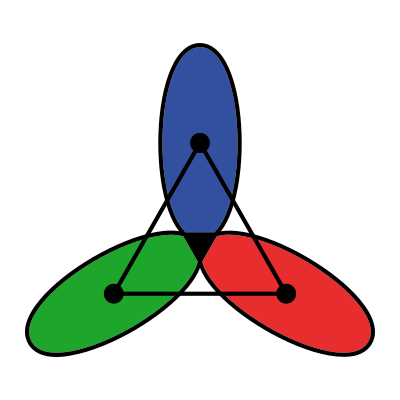
From the Archives of the Astromagus Guild
SUBJECT: The Cosmography of the Trynarr System
SOURCE: The Stellarium Codex, Astromagus Guild
Records
To the uninitiated, the sky of the Trynarr System is a chaotic tapestry of shifting lights. To the Astromagus, it is a clockwork masterpiece of gravity and magic. Unlike standard systems governed by a single solar anchor, our world exists within a Trinary Star System.
The Trinary Configuration
Three suns orbit a central, super-dense nebulous core known as the Cendith Cloud (or The Anomaly). This central mass is far more than dust; it houses a dense asteroid belt, several barren planetoids, and a swarm of erratic comets that occasionally streak across our skies.
Each sun anchors its own solar family, consisting of several uninhabitable rock or gas giants, but only one life-sustaining world per star. These three suns create the distinct orbital paths that weave around the center like the strands of a braid.
- Rujin (The Crimson Sun): A red giant that casts a harsh, heating glare.
- Sapphyrus (The Azure Sun): A hot, blue-white star that dominates the ultraviolet spectrum.
- Emrallt (The Verdant Sun): A stable yellow-green star providing temperate energy.
The Planetary Triad
The three inhabited worlds of our system do not share an orbit; they possess independent trajectories around their respective suns. While they share a nearly identical "Universal Day" (one full axial rotation), their orbital velocities differ, creating the complex mathematical rhythm of our calendar.
| Planet | Parent Sun | Year Length | Primary Environment |
|---|---|---|---|
| Rojord | Rujin | 360 Days |
Arid Deserts, Iron Mountains |
| Caeruleus | Sapphyrus | 348 Days |
Global Oceans, Archipelagoes |
| Gyrwinn | Emrallt | 350 Days |
Temperate Forests, Glades |
The Mechanics of Conjunction
Because the planets orbit at different speeds, their positions relative to the central Cendith Cloud are rarely synchronized. However, mathematics dictates that their paths must cross. These intersection events are known as Conjunctions.
During a conjunction, the involved planets pass through the outer or inner bands of the Cendith Cloud simultaneously. The gravitational and atmospheric interaction between the worlds results in predictable, albeit dangerous, meteorological phenomena.
The Minor Conjunctions
These two-planet alignments occur frequently within a human lifespan. While they disrupt local weather patterns, they are considered standard navigational hazards.
- The Steam Storms (Rojord & Caeruleus): Occurs every ~29 years. The heat of the Red Planet meets the moisture of the Blue Planet, generating massive global hurricane systems.
- The Dust Blight (Rojord & Gyrwinn): Occurs every ~35 years. Atmospheric bleed pulls red sand from Rojord into Gyrwinn's skies, creating choking smog and agricultural droughts.
- The Drowning (Caeruleus & Gyrwinn): Occurs every ~175 years. A rare gravitational lock that swells the tides, flooding coastal regions on both worlds.
The Grand Alignment
The apex of our celestial mechanics is the Grand Cycle. Every 365,400 days (approximately 1,000 years), the mathematical Least Common Multiple of the three orbits is achieved.
In this moment, all three planets align perfectly within the densest heart of the Cendith Anomaly. The gravitational stress of this tri-planetary lock results in a "Geophysical Cataclysm." Tectonic plates shift, climates invert, and the magnetic fields of the system twist violently. It is a time of global reshaping, where the very map of the world is redrawn by the hand of gravity.
No comments:
Post a Comment
Well met, travelers! Pull up a chair by the hearth. I invite you to leave your mark within these scrolls. Whether you offer praise, critique, or fresh counsel, I welcome your thoughts as I continue to weave this tapestry. The Chronicler reviews all missives before they are unsealed for the public eye.